
Home Balance Exercises vs Vertigo Program
Disclosure: this page contains affiliate links (ClickBank). If you buy through them we may earn a commission at no extra cost to you. The publisher gave us free access to the full program so we could read it for this review. Educational content only, not medical advice.
Home balance exercises vs The Vertigo and Dizziness Program is really a question about money and structure. Standard balance exercises are free: clinics hand them out, and good versions are easy to find. The program costs about $49 at the time of writing. So what does the paid guide give you that a printed sheet does not, and when is the free route perfectly enough? Here is a straight comparison.
What “home balance exercises” usually means
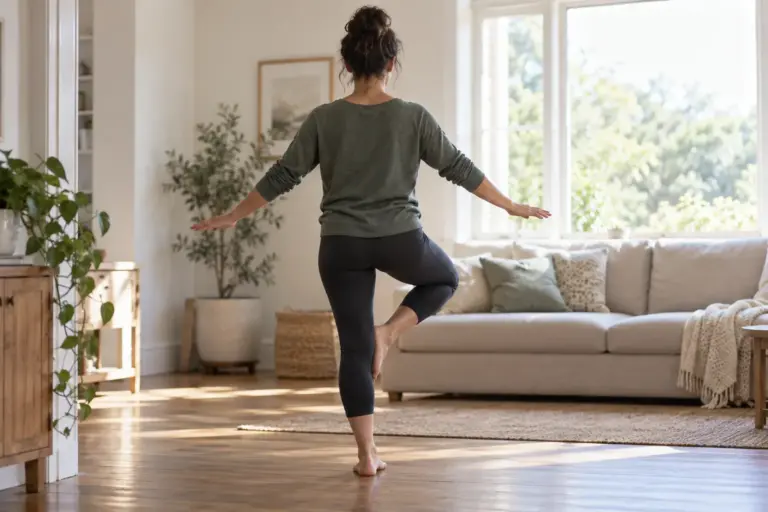
- Static balance: standing with feet together, then one in front of the other, then on one leg, holding a counter.
- Dynamic balance: heel-to-toe walking, turning while walking, stepping over small objects.
- Gaze stabilisation: keeping your eyes on a target while you move your head side to side.
- Habituation: repeating a movement that makes you mildly dizzy, so your brain stops overreacting to it.
- Brandt-Daroff: a specific sit-to-lie sequence sometimes used for BPPV symptoms.
These are the building blocks of vestibular rehabilitation, and they work best when someone picks the right ones for you. See the best exercises for BPPV if that is your diagnosis.
What the program adds
The Vertigo and Dizziness Program packages four groups of posture holds, jaw and throat exercises, gentle neck movements and relaxation routines into a routine the publisher says takes 3 to 15 minutes a day (the PDF’s own timings add up to more). Compared with a free sheet, it adds three things: neck and jaw mobility work that standard handouts often leave out, a set order so you do not have to design a routine, and a small financial commitment that some people find motivating. It does not add an assessment, progression tailored to you, or anything for active BPPV. Details in our full review.
Side by side
| Free home balance exercises | The Vertigo and Dizziness Program | |
|---|---|---|
| Cost | Free | About $49 once, 60-day refund |
| Focus | Standing and walking balance, gaze, habituation | Posture holds, jaw and throat exercises, gentle neck movements and relaxation |
| Structure | Depends on the source; often a loose list | Set routine, short daily sessions |
| Fall-prevention work | Usually included | Less of a focus |
| Neck-related dizziness | Often not covered | Covered |
| Tailored to you | Only if a clinician chose them | No |
| Evidence | Based on rehab methods with trial support | No trial of the branded program |
Prefer a ready-made routine? See the program →
Which to choose
- You were given exercises by a clinician: do those. Add nothing unless they agree.
- Your main problem is falls or walking: free balance training, ideally with a physiotherapist, fits better than the program.
- Stiff neck, tension and dizziness together, serious causes ruled out: the program’s neck and jaw work is a reasonable pick.
- You never stick with anything: a short, fixed routine you paid for may be the nudge you need, and the refund covers the downside.
FAQ
Can I combine free balance exercises with the program?
Yes. Many people do standing balance work for fall prevention and use the program for head and neck mobility. Keep total sessions short at first.
Are free vertigo exercises as good as a paid program?
The exercises themselves are often similar. What differs is structure and coverage, not quality.
How often should I do balance exercises?
Most home plans are daily, in short sessions, for several weeks. Follow a clinician’s advice if you have it.
Free exercises are not second-best; they are the foundation. The program is a convenience layer on top, worth paying for only if the convenience is what has been missing.
Check the program and its refund →
How we reviewed this (updated 20 October 2026): this page is based on the vendor’s official information, pricing and policies. We read the member copy of the program that the publisher provided free of charge; we have not followed the program or tested its results.