
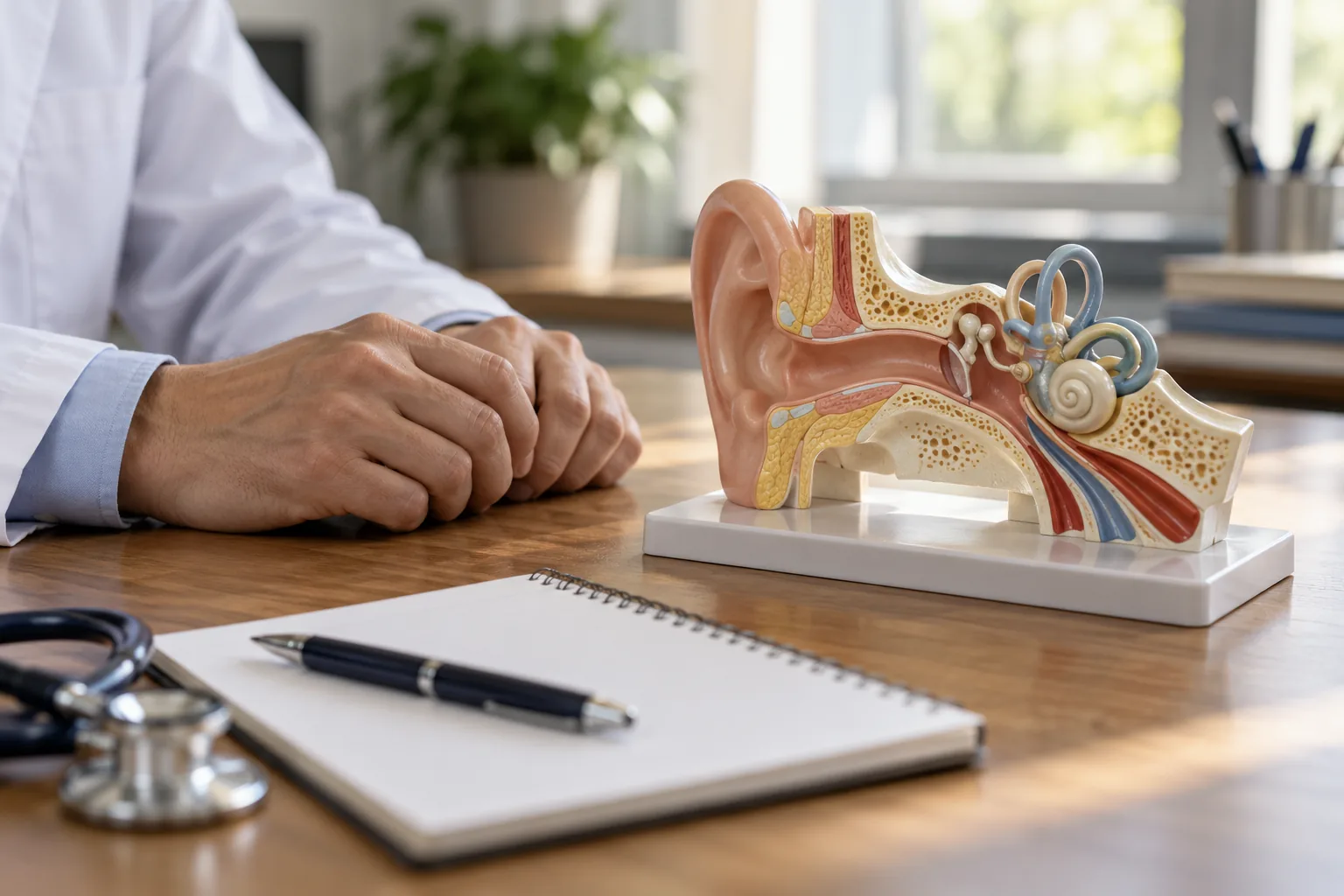
Vestibular Migraine vs Meniere’s
Disclosure: this page contains affiliate links (ClickBank). If you buy through them we may earn a commission at no extra cost to you. Educational content only, not medical advice.
Vestibular migraine and Meniere’s disease are two of the most commonly confused causes of recurring vertigo, and it’s easy to see why: both cause episodic attacks, both can include some degree of nausea, and both are diagnosed largely by pattern rather than a single definitive test. Getting the distinction right matters because the long-term management is genuinely different.
The key difference: hearing
The clearest distinguishing feature is what happens to hearing. Meniere’s disease typically involves fluctuating hearing loss, tinnitus (ringing or roaring), and a feeling of fullness in the affected ear, usually one-sided, and these hearing changes tend to worsen gradually over years even between vertigo attacks. Vestibular migraine, by contrast, generally spares hearing; while some people report mild sound sensitivity during an episode, true progressive hearing loss isn’t part of the typical picture.
Attack length and pattern
Meniere’s attacks classically last between twenty minutes and several hours, often described as a distinct, severe episode that resolves relatively predictably within that window. Vestibular migraine episodes are more variable, ranging from a few minutes to several days, and the sensation itself can range from true spinning to a vaguer floating or rocking feeling, which Meniere’s attacks usually don’t produce; Meniere’s vertigo tends to be intense, true rotational spinning throughout the attack.
Headache and migraine history
A personal or family history of migraine makes vestibular migraine more likely, though its absence doesn’t rule it out, since vestibular migraine can appear without a strong prior headache history. Meniere’s disease has no particular link to migraine history, though the two conditions can coexist in the same person, which is part of what makes diagnosis genuinely tricky in some cases.
| Feature | Vestibular migraine | Meniere’s disease |
|---|---|---|
| Hearing loss | Not typical | Progressive, fluctuating |
| Tinnitus, ear fullness | Uncommon | Common |
| Attack length | Minutes to days | Roughly 20 minutes to hours |
| Headache | Sometimes | Not typically part of it |
| Progression over years | Variable, often stable | Often progressive |
How doctors actually tell them apart
Diagnosis usually combines your symptom history, a hearing test to check for the fluctuating pattern typical of Meniere’s, and sometimes balance testing. Because the conditions can overlap or coexist, an ENT or neurologist experienced with vestibular disorders is often better positioned to sort this out than a general checkup alone, particularly if your pattern doesn’t fit either description cleanly.
See realistic results from a general home routine →
Why the distinction changes treatment
Meniere’s management often centers on dietary sodium control, diuretics, and other ENT-directed options aimed at inner-ear fluid balance, since the underlying issue is thought to involve fluid pressure in the inner ear. Vestibular migraine management leans on standard migraine tools: trigger identification, lifestyle consistency, and preventive medication for frequent episodes. Treating one condition’s plan as if it applies to the other rarely works well, which is exactly why getting the label right matters beyond curiosity.
Frequently Asked Questions
Can someone have both conditions at once?
Yes, though it’s uncommon, and when it happens it can make diagnosis and treatment more complicated, usually requiring closer specialist involvement.
Does tinnitus always mean Meniere’s?
No, tinnitus has many causes, but persistent tinnitus alongside episodic vertigo and any hearing change is a reasonable reason to specifically ask about Meniere’s.
Is one condition more serious than the other?
Both are manageable chronic conditions rather than emergencies on their own, though Meniere’s progressive hearing risk makes early ENT involvement particularly worthwhile.
Which specialist should I see first?
An ENT is a reasonable first stop for either, since a hearing test is a quick, useful way to start narrowing things down, with referral to a neurologist if migraine features dominate.